


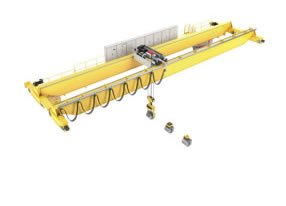
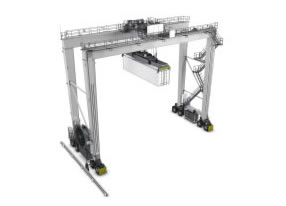
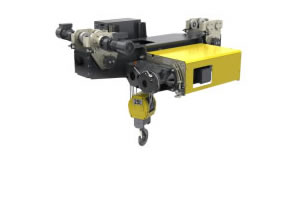
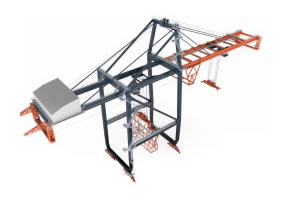

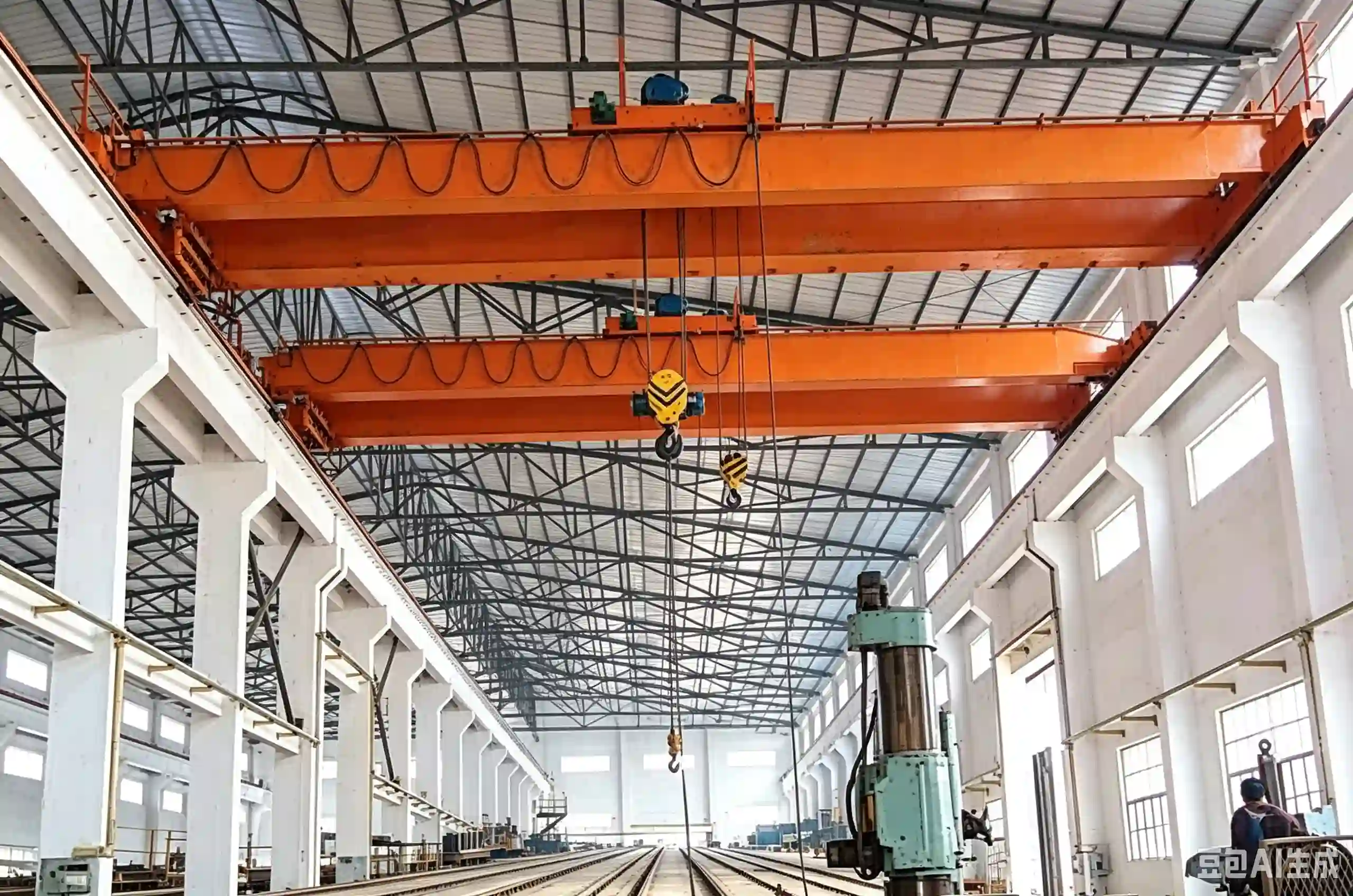
In modern industry and construction sectors,double girder bridge cranes are mostly applied for indoor materialhandling operations. Unlike singlegirder overhead cranes, this materialtransport system is composed of two loadbearing main girders, endcarriage travelling mechanisms and a lifting trolley assembly.
What Advantages Does a Double Girder Bridge Crane Have Compared With a SingleGirder Overhead Crane?
Higher Rated Lifting Capacity
Imagine this: When lifting heavy objects, the total weight of all the items (including the weight of the trolley and the load) is 100% applied to a single main beam. Once the weight exceeds a certain limit (typically 20 tons), the single-beam crane will no longer be able to support it.
For double girder bridge cranes, the hoist trolley is mounted across the top of two parallel main girders. Load forces are evenly distributed onto both main girders through four trolley wheels. Each girder bears approximately 50 % of the vertical load, so material stress levels are cut in half.
Apart from beam structures, the hoist mechanism is another critical factor that determines lifting capacity.
Compact electric hoists are suspended underneath singlegirder cranes. Confined installation space prevents the fitting of largesize motors and heavyduty wire ropes, hence maximum pulling force is limited.
The double-girder crane, on the other hand, directly constructed a spacious and stable "double-track platform". The "heavy-duty winch" was securely attached to the top of the two main girders like a trolley. With this prime location, not only could extremely powerful large motors and large gearboxes be accommodated, but also the steel wire rope could be gradually enlarged and the pulling force increased layer by layer like a "jack", resulting in an astonishingly huge amount of force!
Improved Lifting Height
The hook of a conventional singlegirder overhead crane is positioned below the main girder, so lifting travel is physically restricted. Trolleys of doublegirder cranes run inboard between two parallel main girders. When the hook is hoisted to its upper limit, the hook block can pass through the gap between the two girders and rise into the intermediate space, even slightly above the girder bottom flange. Unlike singlegirder designs, no blockage from the bottom of a single beam is encountered, and effective lifting height is greatly increased.
Extended Span Capability and Higher Operation Stability
Comparison Criteria |
Single Girder |
Double Girder |
Bending & Torsional Stiffness |
Smaller cross-section and longer spans can result in greater beam deflection, making the crane more susceptible to lateral movement and skewing. |
Twin box girders form a rigid spatial frame, providing higher bending and torsional stiffness and excellent structural stability. |
Rail Pressure & Wear |
On long-span cranes, beam deflection and uneven loading can contribute to wheel and rail wear. |
Better load distribution and synchronized wheel travel help minimize lateral movement and rail wear. |
Applicable Span Range |
Typically 7.5–22.5 m; generally suitable for spans up to 30 m. |
Typically 10.5–31.5 m; customized designs can accommodate spans of 40 m or more. |
Breaking Through Long-Span Limitations
Why Single Girder Cranes Become More Challenging at Longer Spans
A single girder crane is supported by just one main girder. Once the span goes beyond 25 meters, the middle of the girder can start to deflect under its own weight and the working load.
To keep that deflection under control, the girder has to be made deeper and heavier. As a result, the crane's own weight goes up quickly, and the overall cost can increase significantly. During operation, more vibration and sway may also be felt, especially when the crane is traveling or stopping.
How the Double Girder Structure Helps
With a double girder crane, two main girders are connected by the end trucks, creating a rigid box-type structure.
This makes a noticeable difference when longer spans are involved. In workshops with spans of 30 to 40 meters or more, the structure is better able to handle the sideways forces produced when the crane is started or stopped.
As a result, the crane can be kept more stable during long-span travel, with less sway and more accurate positioning. Even when the crane is moving across a large workshop, the operation feels much steadier and more controlled.
Higher Duty Classification
Single girder cranes are generally designed for lighter-duty applications, such as workshops, assembly lines, and maintenance areas, where the crane is used intermittently and heavy loads are not handled continuously. These applications typically fall within A3–A5 duty classes.
When a single girder crane is used for much more demanding work, the connection between the electric hoist and the main girder can be subjected to repeated heavy loads. Over time, this can lead to metal fatigue and premature wear or damage.
Double girder cranes, especially QD-type double girder overhead cranes with hoisting mechanisms, can be designed for the highest duty classes, A7–A8.
This means they can be used in much more demanding environments, such as foundries and metallurgical plants, power plants with grab buckets, steel rolling mills, and scrap-handling terminals. In these applications, the crane may be exposed to high temperatures, heavy dust, continuous 24-hour operation, and long periods of operation at or near rated load.
Easy to Maintain
Like any crane, a double girder or single girder crane will experience some wear over time. Wheels, bearings, wire ropes, brakes, and electrical components all need to be inspected and maintained regularly. Routine inspection and maintenance are therefore an important part of keeping the crane running safely and reliably.
With a single girder overhead crane, routine inspections, lubrication, repairs, or component replacement can be more difficult. Additional access equipment, such as scaffolding or a mobile elevating work platform, may be needed because the single girder is relatively narrow and does not provide a dedicated, stable walkway for maintenance personnel.
With a double girder overhead crane, the two parallel main girders provide a more accessible working area. A stable walkway is formed between the girders, allowing maintenance personnel to move around the crane more easily and safely.
Many routine maintenance tasks can be carried out while standing, including visual inspections, mechanical lubrication, bolt tightening, electrical checks and adjustments, inspection of wind protection devices, and troubleshooting.
Good maintainability can make a real difference over the long term. Less labor is required, safety risks can be reduced, and downtime can be kept to a minimum. More importantly, the crane can be kept in good working condition throughout its service life.
For factories and industrial projects where cranes are used frequently and for long periods of time, easier maintenance can help keep operations running smoothly while reducing the overall cost of ownership.
Types of Double Girder Overhead Cranes for Different Working Conditions
European-Style Double Girder Overhead Crane
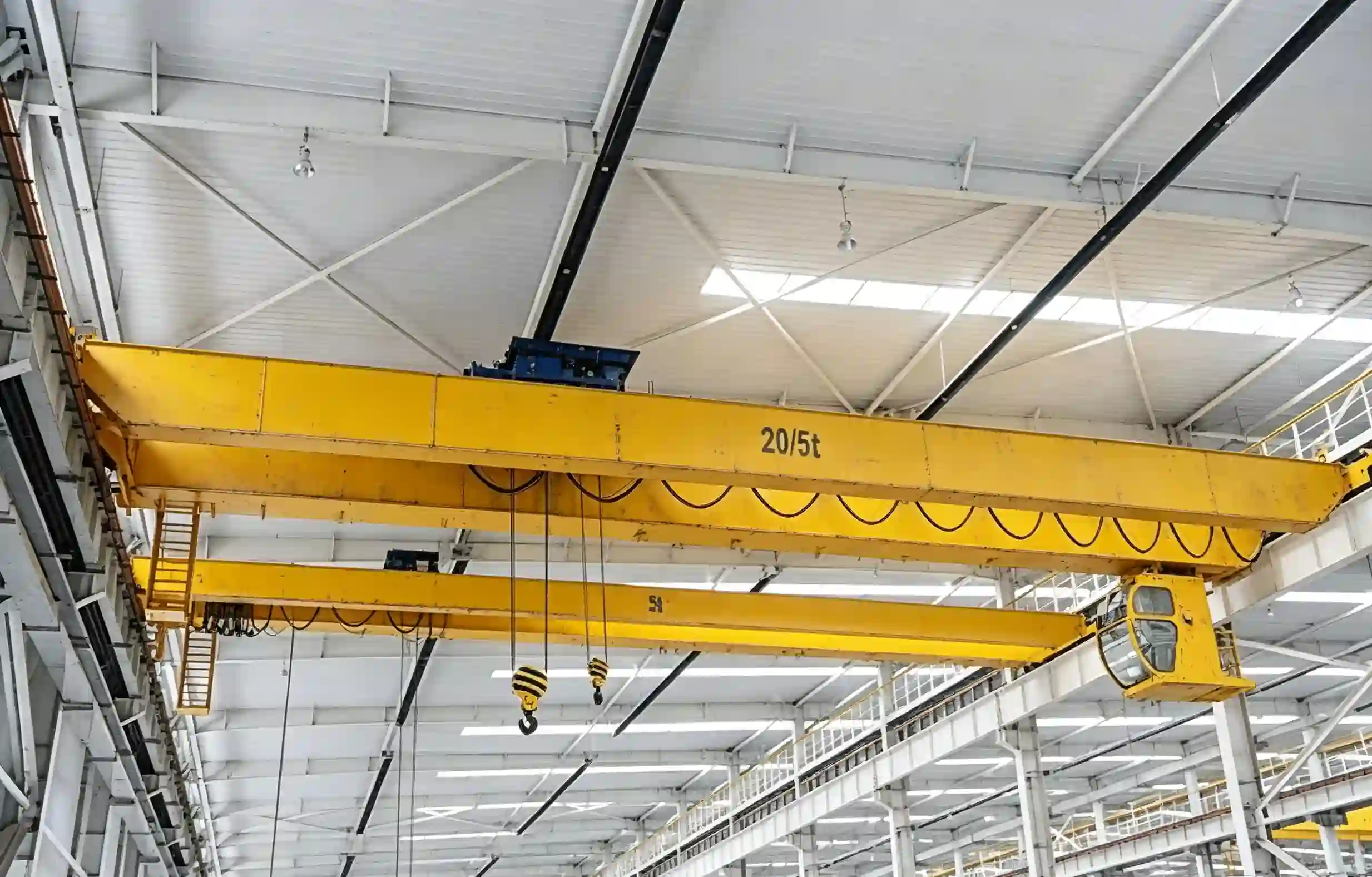
This new generation of crane is designed and manufactured in accordance with FEM standards. It can be seen as an updated approach to conventional crane design, with a focus on keeping the overall structure lighter while maintaining the required strength and rigidity.
Because the crane is lighter, less load is transferred to the building structure. This can be particularly useful when an existing or older workshop is being upgraded. In many cases, extensive reinforcement of the concrete columns may not be required, which can help keep the building modification work simpler and the overall project cost under control.
The lighter crane structure also means that less space is taken up by the crane itself, leaving more usable space in the workshop.
If you need better positioning accuracy, more usable space, lower noise levels, or reliable performance during long periods of continuous operation...
Double Girder Grab Crane
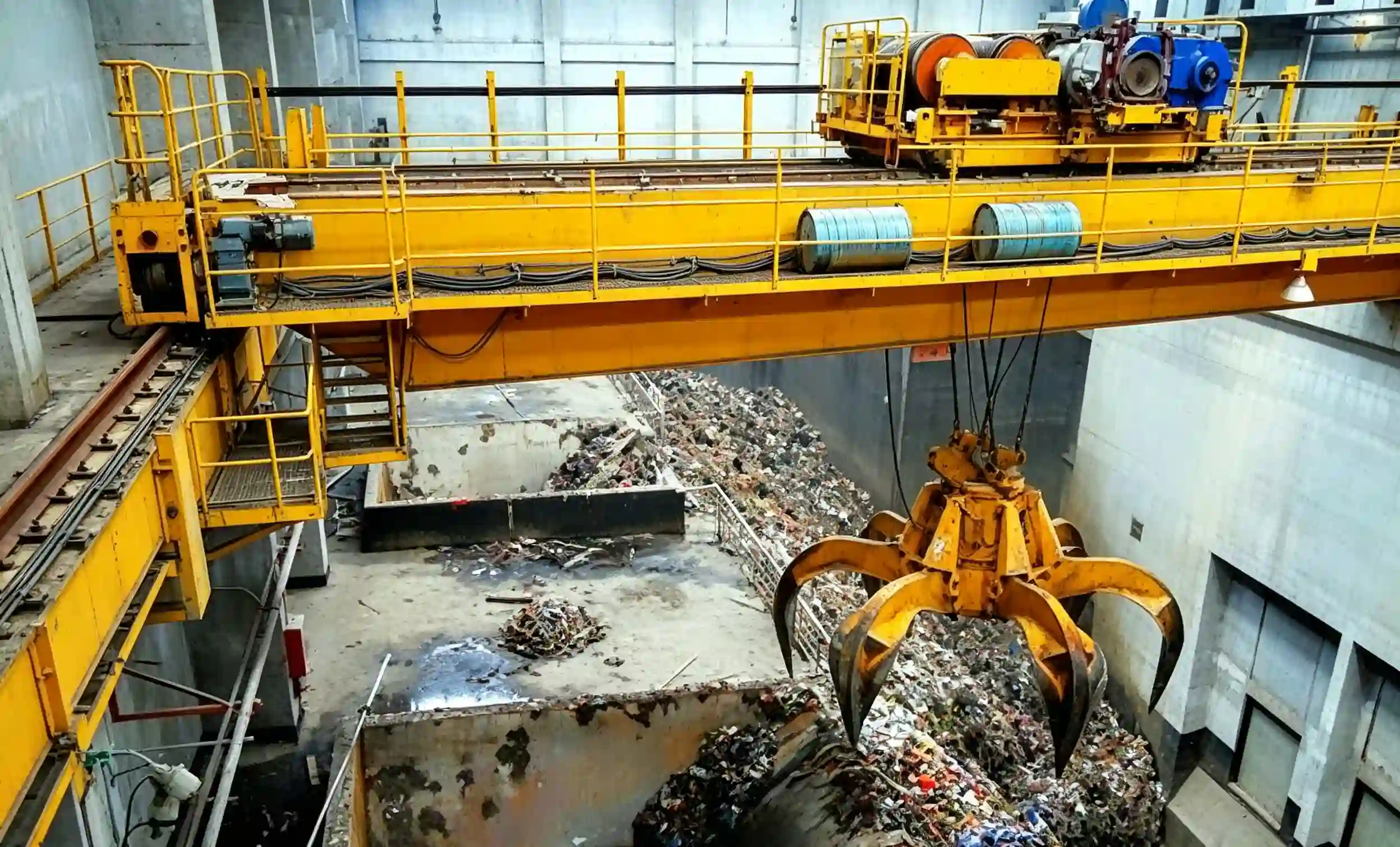
This double girder overhead crane is designed specifically for bulk material handling and is typically used for heavy-duty industrial applications, with standard duty classes of A6, A7, and A8.
The grab bucket is opened and closed by a four-rope, twin-drum hoisting mechanism mounted on the trolley. Combined with the travel movements of the bridge and trolley, the crane can carry out the complete material handling cycle, including grabbing, lifting, transporting, and unloading bulk materials.
It is commonly used in ports, factories, workshops, power plants, steel mills, cement plants, and waste-to-energy facilities, where bulk materials need to be loaded, moved, and unloaded on a regular basis.
Explosion-Proof Double Girder Overhead Crane
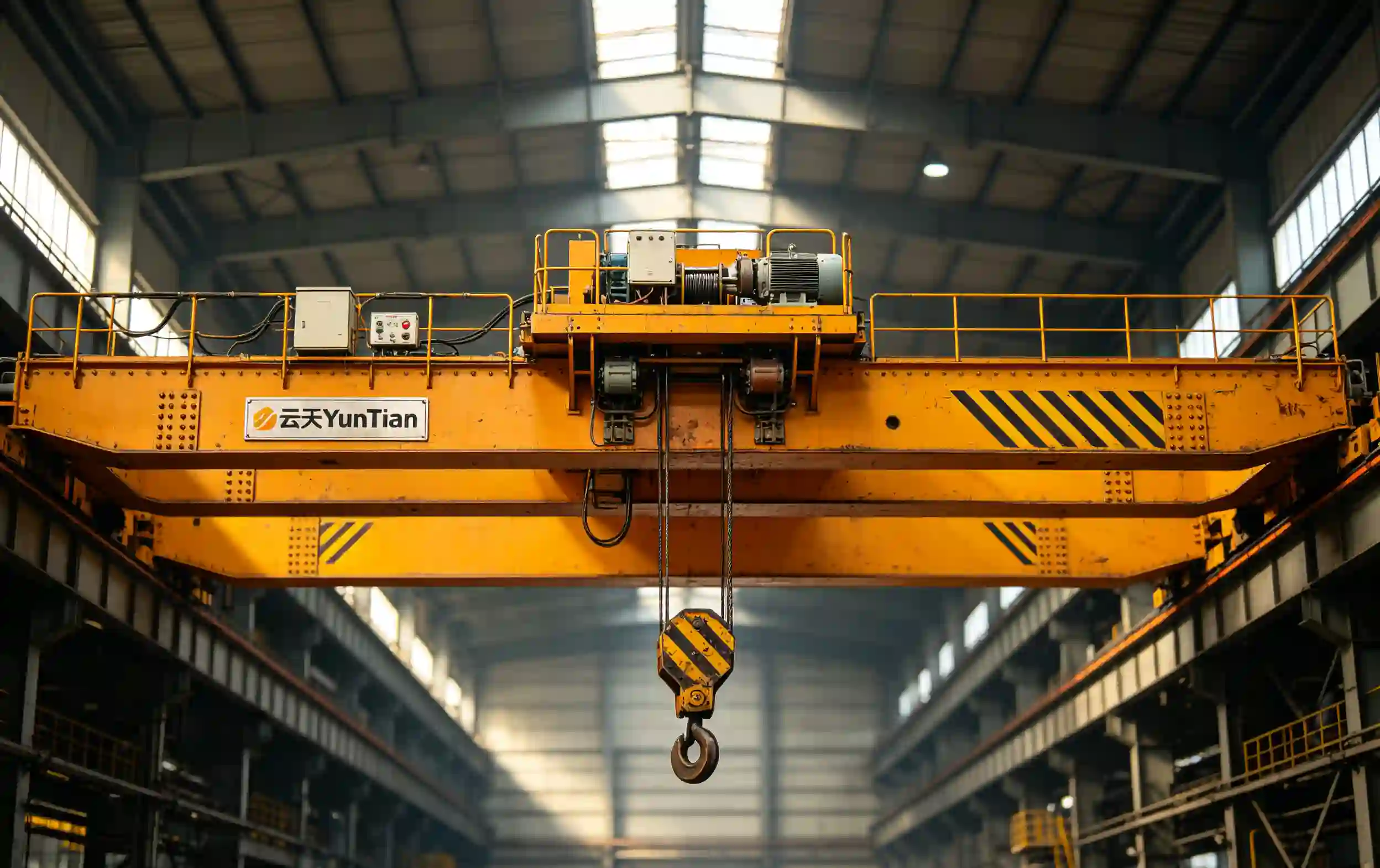
This explosion-proof double girder overhead crane is designed for use in hazardous environments where flammable gases, vapors, or dust may be present. Explosion-proof measures are applied to the motors and electrical components, allowing the crane to be used in areas where there is a risk of fire or explosion.
The crane is marked ExdeibIICT4 / DIP A21 TA, T4 and can be configured for environments requiring IIB or IIC explosion protection. It can also be used in areas where combustible dust is present.
It is commonly used in factories, warehouses, and material storage facilities, as well as in industries such as military applications, chemical processing, coal preparation, and pharmaceuticals.
Electromagnetic Double Girder Overhead Crane
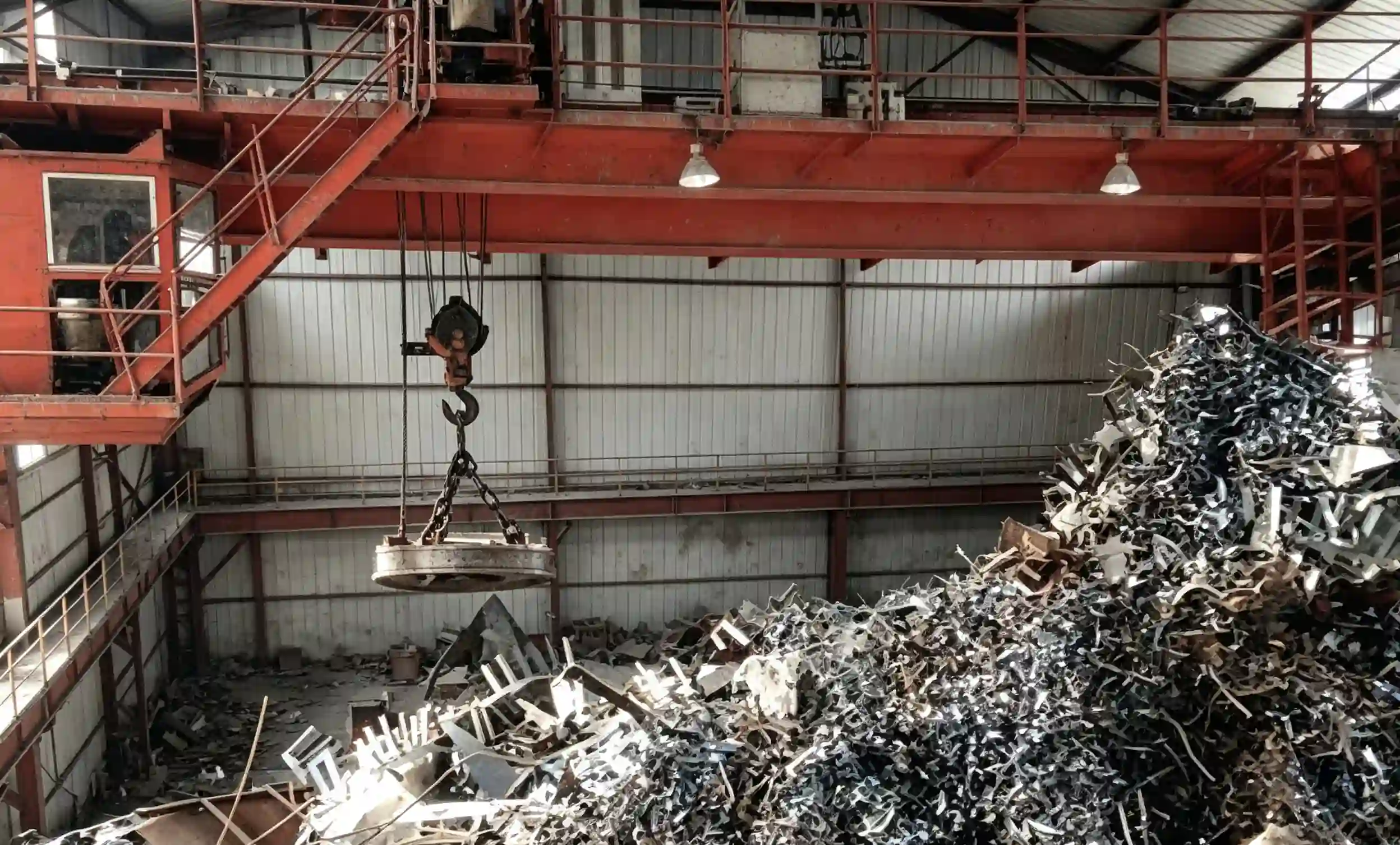
If you need to move steel plates, scrap steel, or other ferrous materials, the traditional method often involves securing the load with wire ropes and manually attaching and removing hooks. It takes time and also requires more manual work.
An electromagnetic double girder overhead crane makes this process much simpler. The electromagnetic lifting magnet is energized to pick up the material and de-energized to release it, so no slings or manual hooking are needed. The material can be picked up and released directly, allowing one operator to handle the lifting operation.
This can reduce the amount of manual handling required and shorten the loading and lifting cycle, especially when materials need to be moved frequently.It is widely used in steel plants, scrap yards, warehouses, metal processing workshops, foundries, and recycling facilities.
Metallurgical Foundry Double Girder Overhead Crane
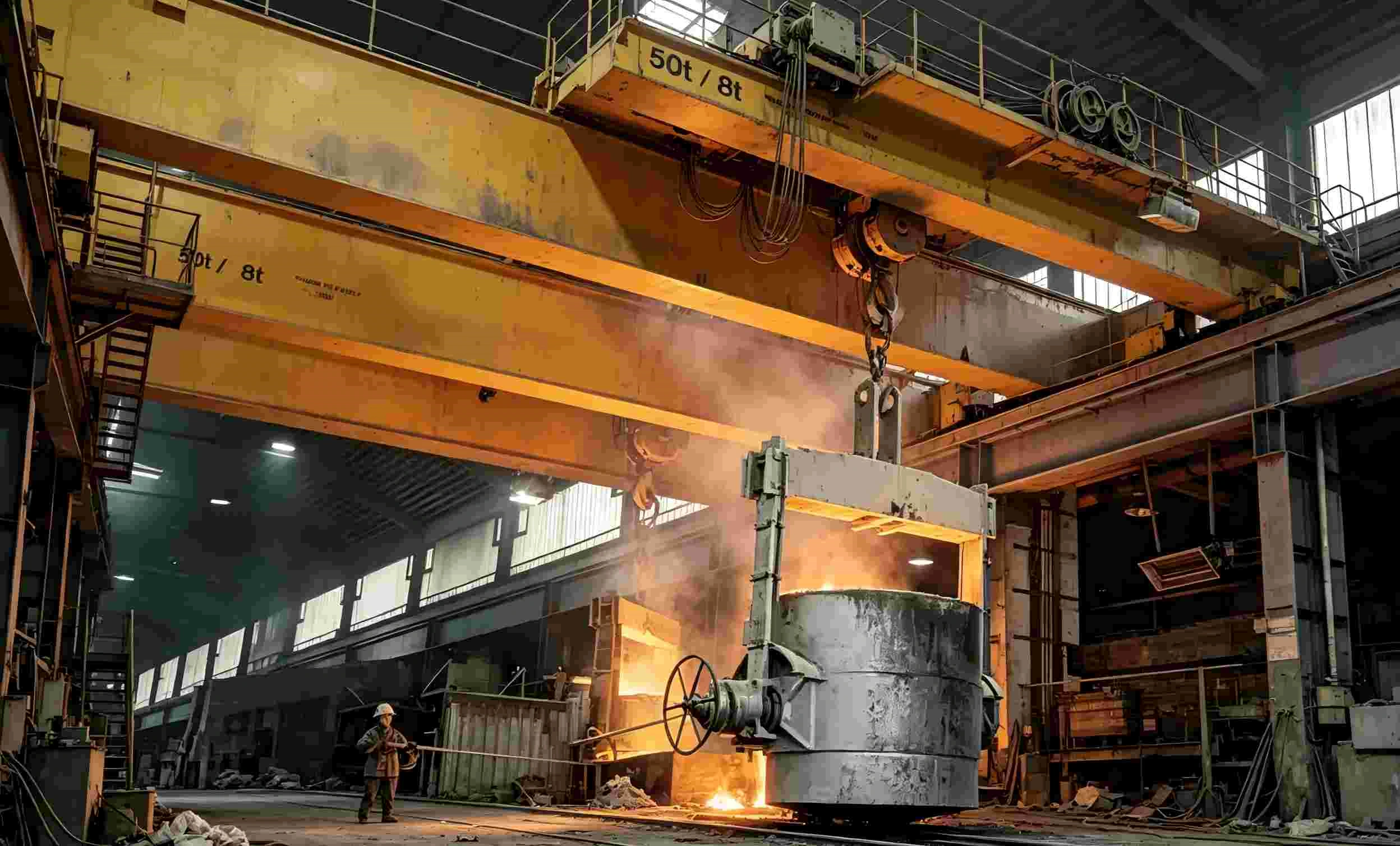
If you need to handle molten steel or molten iron, a standard overhead crane may not be suitable for the high temperatures found in steelmaking and large foundry workshops. The safety features and overall configuration may also not be designed for this type of work.
A metallurgical foundry crane is specifically designed for these demanding applications. The crane is built to withstand high temperatures and heavy-duty operation, and it can be used for long periods without frequent stops.
It is typically equipped with two hooks, a main hook and an auxiliary hook. The main hook is used to safely lift a ladle filled with molten steel, while the auxiliary hook can be used to tilt the ladle and pour the molten metal, as well as assist with slag removal and equipment maintenance. The two hooks can be operated together to support the different steps involved in the pouring process.
The operator is normally seated in an enclosed, air-conditioned cabin, where they are better protected from the heat, smoke, and dust in the workshop. This also makes it easier to operate the crane for extended periods.
Choosing Yuntian as Your Double Girder Overhead Crane Supplier
Yuntian is focused on professional, innovative, and customized crane solutions, with a particular focus on non-standard lifting equipment.
We understand that every operation is different. The right crane depends on the actual working conditions at your site, including the rated lifting capacity, span, lifting height, and workshop structure and layout.
Based on these requirements, we can work with you to develop a material handling solution that fits your specific application, rather than simply providing a standard crane.
Conclusion
With their stable structure, high load capacity, ability to cover longer spans, and easier maintenance, double girder overhead cranes are a reliable choice for demanding material handling applications.
They can take much of the manual work out of the job, make daily operation easier, and help get more work done in less time. With the right crane configuration, many common problems that can occur during material handling can also be reduced, making day-to-day operation safer, smoother, and more reliable.


